Clear The Air Ships Air Pollution Blog Rotating Header Image

Legco backing for cleaner vessel fuel

http://rthk.hk/rthk/news/englishnews/news.htm?main&20130722&56&937097

Legco backing for cleaner vessel fuel

22-07-2013

Legislators have expressed support for a proposed law that will require all ocean-going vessels to switch to cleaner fuel (only) while at berth in Hong Kong.

Authorities say this could reduce emissions of sulphur dioxide city-wide by 14-percent. The legislation is expected to take effect in 2015.

Wu Chi-wai of the Democratic Party said it’s a good step forward, but he hopes similar rules can be implemented quickly throughout the Pearl River Delta region.

OCEAN GOING VESSELS – SHIPPING – HONG KONG ‘S BIGGEST POLLUTION SOURCE

Download PDF : OCEAN GOING VESSELS

Environment: Russia delays tougher marine emissions standards – FT.com

http://www.ft.com/cms/s/0/4a67c6b6-d125-11e2-be7b-00144feab7de.html

June 19, 2013 11:49 pm

Environment: Russia delays tougher marine emissions standards

By Don Hoyt Gorman

Stringent new emissions standards for yachts have been delayed after a
surprise intervention by the Russian delegation at a meeting of the
International Maritime Organisation (IMO) – the highest authority on
marine pollution by shipping.

At last month’s meeting the introduction of the toughest restrictions
yet was postponed for five years to 2021. The decision followed
Russian pressure that took the US delegation, who backed the original
plan for introduction in January 2016, by surprise.

More

On this story
Yachts & Marinas Highs and lows reflect tough time for sailing
Yachts & Marinas Facilities
Yachts & Marinas Finance
Yachts & Marinas Economy
Yachts & Marinas India

On this topic
Russia and Germany in ‘looted’ art spat
beyondbrics Russia joins the rout
Russia runs out of room to expand economy
New trade routes – Russia Rail freight

IN Yachts and Marinas 2013
Yachts & Marinas Opinion, by Martin Redmayne
Yachts & Marinas Competition
Yachts & Marinas Chartering
Yachts & Marinas Boatbuilding

The new standards known as IMO Tier III mean that all ships, including
superyachts, will have to reduce their emissions drastically,
requiring the installation of selective catalytic reduction (SCR)
systems. Yacht builders were concerned that the systems – which are
relatively large and complex – would not fit into the engine rooms of
yachts below the 500 gross ton threshold. Shipyards and designers were
studying redesigns, in some cases eliminating a guest cabin to house
the required exhaust after-treatment system.

In a segment heavily reliant on charter, worries about the potential
loss of 20 per cent of a vessel’s guest capacity, plus the increased
costs of installation and maintenance of new systems prompted industry
representations.

The primary lobbying body, the International Council of Marine
Industry Associations (Icomia), conducted an investigation and
presented its argument to the IMO in May. Citing significant economic
impact on a sector of the yachting industry, Icomia asked for a
three-year delay to allow innovations in SCR technology to reduce the
size of the systems.

According to data from the industry resource
SuperyachtIntelligence.com, the yards most likely to be affected by
the Tier III limits are Azimut, Pershing (Ferretti), Sanlorenzo,
Overmarine, Leopard and Sunseeker. It was not only the boatyards that
faced pressure from the IMO regulations – most smaller high-speed
yachts are powered by the M94 or M93 power plant from the German
engine manufacturer MTU.

But at the meeting of the IMO’s marine environmental protection
committee in London in May, Icomia’s argument – which had been
supported by delegations from the Marshall Islands and the Cook
Islands – was overshadowed by the Russian proposal. Russia’s move
successfully got the IMO to declare the five-year delay in the onset
of the emissions limits for all types of vessel, worldwide.

As a result, yacht builders and engine manufacturers are now likely to
spend this time researching and designing both yachts and engines that
are Tier III compliant.

The US delegation to the IMO is strongly in favour of the Tier III
emission limits, and, by their own admission, did not foresee the
Russian move.

Jeffrey G. Lantz, director of commercial regulations and standards
with the US Coast Guard and head of the US delegation to the IMO,
says: “The US argued to retain the worldwide 2016 timeline. It was
only after the decision … to agree with Russia’s worldwide 2021
proposal that the US proposed keeping the 2016 date for the North
America and Caribbean Sea Emission Control Areas (ECAs), but retaining
the Russia 2021 timeline for yachts under 500 gross tons, as proposed
by the Marshall Islands and Cook Islands.

“The primary reason for the US opposition to a delay … for the North
America ECAs is to improve the air quality from the impact of today’s
marine vessels for the health and welfare of US and Canadian
citizens,” Mr Lantz adds.

“US engine manufacturers have made significant investments and are
prepared to meet the Tier III standards in 2016. Unfortunately, this
proposed delay removes certainty and regulatory predictability, which
is important for their business planning.”

The Russian proposal is expected to be adopted at the next IMO’s
environmental protection committee meeting in spring 2014, and is not
expected to be challenged or overturned.

Copyright The Financial Times Limited 2013. You may share using our
article tools.
Please don’t cut articles from FT.com and redistribute by email or
post to the web.

The impact of international shipping on European air quality and climate forcing

Download PDF : The impact of international shipping on European air quality and climate forcing

Shipping emissions associated with increased cardiovascular hospitalizations

http://www.sciencedirect.com/science/article/pii/S1352231013002598

Highlights
•Nickel and vanadium in PM10 are indices of shipping air pollution.
•Nickel and vanadium were associated with elevated cardiovascular hospitalizations.
•Nickel appeared to correspond better than vanadium to cardiovascular health.
•Controlling residual oil emissions is important in port cities.

Abstract

Previous studies have suggested nickel (Ni) and vanadium (V) as the likely constituents that are partially responsible for health effects associated with particulate matter pollution. The authors aimed to examine the effects of Ni and V in PM10, the indices of shipping emissions, on emergency hospitalizations for cardiovascular diseases (CVD) in Hong Kong. Daily PM10 speciation data across six monitoring stations in Hong Kong during 1998–2007 were collected. Generalized additive Poisson models with single-day lags were used to estimate the excess risks of emergency hospital admissions for CVD associated with Ni and V, after adjusted for major PM10 chemical species and criteria gaseous pollutants. The excess risks for inter-quartile range (IQR) increases of Ni and V on the same day and previous six days (lag0 ∼ lag6) were estimated. Ni in PM10 was associated with a 1.25% (95%CI: 0.81–1.68%) increase of total emergency CVD admissions on the same day, while lag0 V was associated with a 0.95% (95%CI: 0.55–1.35%) elevated CVD admissions. The associations were not sensitive to the further adjustment for co-pollutants. Ni appeared to correspond better than V to cardiovascular health. Controlling shipping emissions from residual oil combustion in the port cities like Hong Kong is particularly important.

1-s2.0-S1352231013002598-fx1

Marine diesel must be 10 times cleaner by 2014

Saturday, 23 March, 2013, 12:00am

News›Hong Kong

ENVIRONMENT

Cheung Chi-fai chifai.cheung@scmp.com

Around 15,000 vessels would switch to diesel with 10 times less sulphur under proposed rules

Over 15,000 diesel-powered vessels could be forced to use fuel with 90 per cent less sulphur, after a trial found the cleaner alternative had no impact on vessels’ mechanics or consumption, under a government proposal.

However, some operators fear that the cleaner diesel will push up their running costs – despite government assurances to the contrary.

The proposal will be tabled to the legislature this year and will force operators of vessels, including ferries, high speed boats, barges, tug boats and cross border vessels, to use diesel containing no more than 0.05 per cent sulphur from 2014.

The cap is 10 times stricter than the current 0.5 per cent limit on sulphur in marine diesel.

However, the upgraded fuel still has 50 times more sulphur than the Euro V diesel being used for road transport. That diesel only has 0.001 per cent sulphur.

In a paper submitted to lawmakers yesterday, environment officials said a trial completed in January this year found the cleaner fuel would not damage older engines.

The trial, conducted by University of Hong Kong specialists, also confirmed there was no significant change in fuel consumption or power output after the switch.

Officials said there would not be a substantial difference in costs, as their most updated figures showed the low sulphur diesel was just seven cents per litre more expensive.

They quoted oil companies’ forecasts that the price differential could be even narrower in the future.

Johnny Leung Tak-hing, general manager of Star Ferry, however, remained sceptical over the fuel costs. “The industry is worried whether the seven cents difference is true or not … we hope the government can give us more guarantees and data to support their claims,” he said.

Leung said the government had also tested local vessels on ultra low sulphur diesel, which had a sulphur content of 0.005 per cent in 2001 but concluded that it was too expensive. The government at that time pledged the ultra-low-sulphur diesel would cost just 20 cents more per litre, but the difference rose to around HK$1 eventually, he said.

Officials said the fuel market was a free one and there was nothing the government could do to control price setting.

Leung also said some diesel vessel operators also wanted the government to subsidise them replacing old engines.

“The road transport operators are given subsidies to replace their vehicles. But we have got not even a single cent,” he said.

The Environmental Protection Department estimated that the switch could reduce sulphur dioxide emissions by 3,219 tonnes a year, representing a 19 per cent reduction of the marine sector’s total emissions in 2011.

The marine sector, including ocean-going vessels, has overtaken power plants as the largest source of sulphur dioxide, nitrogen oxides and respirable suspended particles.

Topics:

Marine diesel

sulphur


Source URL (retrieved on Mar 23rd 2013, 6:46am): http://www.scmp.com/news/hong-kong/article/1197457/marine-diesel-must-be-10-times-cleaner-2014

Switch to cleaner fuel to much cleaner air: think tank

Submitted by admin on Mar 6th 2013, 12:00am

News›Hong Kong

MARINE POLLUTION

Keith Wallis keith.wallis@scmp.com

Noxious exhaust emissions from cruise ships calling at the city will be cut significantly if the vessels switch to using low-sulphur fuel or shore power, local think tank Civic Exchange says.

Simon Ng Ka-wing, the centre’s head of transport and sustainable research, said there would have been a 71 per cent cut in sulphur dioxide emissions last year if the 2,185 cruise ships that called at Hong Kong had used low-sulphur fuel instead of the dirtier marine bunker fuel. Particulate matter emissions would have fallen by 60 per cent, he said.

Low-sulphur fuel has a sulphur content of 0.5 to 1 per cent, compared with bunker fuel’s 4.5 per cent.

Based on the 16 cruise ships booked to berth at the Kai Tak cruise terminal between June and April 2014, Ng said, sulphur dioxide emissions would be reduced by 83 per cent and particulate matter by 78 per cent if the vessels used cleaner diesel.

But if they did not, they would emit 43 tonnes of sulphur, 44 tonnes of nitrogen dioxide and 5 tonnes of particulate matter in just this year alone, he said.

Industry sources, however, argue that the vessels calling at Kai Tak in the first year will account for less than 0.4 per cent of the city’s total marine emissions. This included pollution caused by container ships, tankers, river trade vessels, ferries and pleasure craft, they said.

“There would be a very substantial improvement by switching to low-sulphur diesel at berth,” Ng said. This would benefit residents in the pollution hotspots of Tsim Sha Tsui, Hung Hom and Kowloon Bay, where most cruise ships currently moor.

Another option, Ng said, was to use shore power, which was more suitable at Kai Tak where there was space to install the equipment rather than at Ocean Terminal. But more research had to be done to see if shore power was cheaper and environmentally beneficial than low-sulphur diesel, he said.

Civic Exchange hosted a workshop yesterday that attracted about 20 cruise and shipping industry representatives to brief the sector about its cruise ship emissions report.

Ng said the paper was “a first step to engage the cruise industry in Hong Kong”. “By speaking directly to the cruise industry, we shall learn more about … what their major concerns are about government control and regulation,” he said.

Topics:

Marine pollution

Civic Exchange

Cruise Ships


Source URL (retrieved on Mar 6th 2013, 5:51am): http://www.scmp.com/news/hong-kong/article/1180397/switch-cleaner-fuel-much-cleaner-air-think-tank

Ship emissions an afterthought at Hong Kong cruise terminal

http://www.maritimeprofessional.com/Blogs/Far-East-Maritime/March-2013/Ship-emissions-an-afterthought-at-Hong-Kong-cruise.aspx

Ship emissions an afterthought at Hong Kong cruise terminal

by Greg Knowler

Mar 06, 2013, 9:54PM EST

It hardly comes as a surprise to learn that curbing ship emissions at Hong Kong’s new cruise terminal is not regarded as a priority by the Tourism Board.

When it comes to infrastructure projects in Hong Kong, environmental concerns are rarely allowed to stand in the way. The grossly wasteful and pointless Hong Kong-Zhuhai-Macau bridge is a case in point, and we do not have the slightest doubt that the airport’s third runway will go ahead regardless of the cost to taxpayers or the cacophony of protest from green groups.

But we were astounded to see a report by local think tank Civic Exchange that warned of significant ship emissions in the six months after the terminal opens. Cruise ships using its two berths will emit 43 tonnes of sulphur, 44 tonnes of nitrogen dioxide and five tonnes of particulate matter.

Okay, in terms of the marine emissions by container ships and the enormous volume of Pearl River delta traffic in Hong Kong waters such as river trade vessels, tankers and pleasure craft, the cruise terminal’s contribution to the total will be relatively minor.

However, the Civic Exchange report goes on to say the emissions from ships using the cruise terminal can be cut by more than 80 percent if the vessels switch to low sulphur fuel while in port, or even plug in to berth-based electrical power while alongside.

That sounds reasonable and a good idea. Our question is why wasn’t that covered in the environmental impact process before the project was given the go ahead? Why is it that only now, three months before the terminal’s two berths are scheduled to open, these emissions-curbing “options” are being mentioned?

Newspapers reported that the cruise industry is “mulling the feasibility” of introducing low sulphur fuel or onshore power. They are understandably concerned over the costs of adopting a low emissions strategy, and in the absence of legislation forcing shipping to use low sulphur fuel while in port, you can bet the cruise operators will do nothing about it.

The cruise terminal was approved by the former administration of Donald Tsang, a disastrous five-year period in the territory’s history that will be remembered for its profligate infrastructure projects plugged into the public purse.

Still, if the current bunch of clowns running Hong Kong had any testicular fortitude they would ram through mandatory regulation that all vessels switch to low sulphur fuel while at berth, regardless of the cost to shipping.

So far about 570 ships have registered for the Fair Winds Charter, a voluntary scheme to use low sulphur fuel to reduce ship emissions while alongside in Hong Kong. But they have warned that if there is no regulation in place by the end of the year, they will go back to burning the dirty stuff.

Voluntary doesn’t work in business, at least not for long when it is costing shipping companies US$1.5 million a year to use the low emission fuel in port. Make it compulsory or laugh it off.

There are signs that the government is paying more than lip service to environmental protection, but it remains to be seen if this administration puts a higher priority on public health than the previous one.

Ship Pollution Patterns Tracked From Space

http://earthobservatory.nasa.gov/IOTD/view.php?id=80375

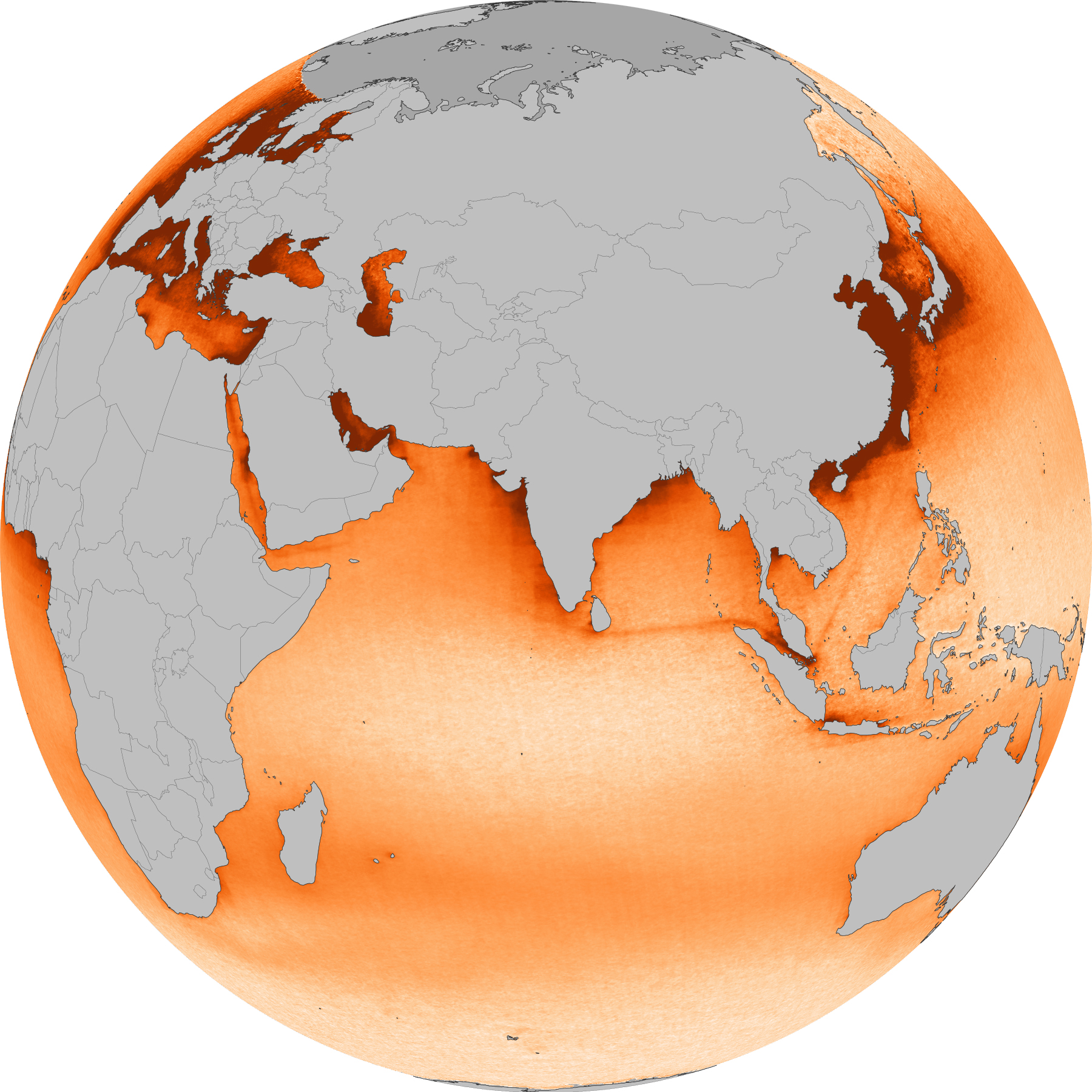
http://eoimages.gsfc.nasa.gov/images/imagerecords/80000/80375/globalno2_omi_2012_lrg.jpg

For more than a decade, scientists have observed “ship tracks”in natural-color satellite imagery of the ocean. These bright, linear trails amidst the cloud layers are created by particles and gases from ships. They are a visible manifestation of pollution from ship exhaust, and scientists can now see that ships have a more subtle, almost invisible, signature as well.

Data from the Dutch and Finnish-built Ozone Monitoring Instrument (OMI) on NASA’s Aura satellite show long tracks of elevated nitrogen dioxide (NO2) levels along certain shipping routes. NO2, is among a group of highly-reactive oxides of nitrogen, known as NOx, that can lead to the production of fine particles and ozone that damage the human cardiovascular and respiratory systems. Combustion engines, such as those that propel ships and motor vehicles, are a major source of NO2 pollution.

The map above is based on OMI measurements acquired between 2005 and 2012. The NO2 signal is most prominent in an Indian Ocean shipping lane between Sri Lanka and Singapore, appearing as a distinct orange line against (lighter) background levels of NO2. Other shipping lanes that run through the Gulf of Aden, the Red Sea, and the Mediterranean Sea also show elevated NO2 levels, as do routes from Singapore to points in China. These aren’t the only busy shipping lanes in the world, but they are the most apparent because ship traffic is concentrated along narrow, well-established lanes.

The Atlantic and Pacific Oceans also have heavy ship traffic, but OMI doesn’t pick up NO2 pollution tracks because the shipping routes are less consistent. The shapes of landmasses force ships into narrow paths in the Indian Ocean, while ships in the Atlantic and Pacific tend to spread out over a broad areas as they navigate around storms.

In addition, the air over the northeastern Indian Ocean is relatively pristine. Heavy NO2 pollution (dark red in the map) from cities and off-shore drilling activity along the coasts of China, Europe, and the United States obscures the ship tracks that might otherwise be visible to OMI. In the map, the Arctic is gray because the lack of light during the winter and frequent cloudiness during the summer prevented OMI from collecting usable data in the area.

Urban areas and industrialization aren’t the only source of NO2 in the map. Agricultural burning in southern Africa and persistent westerly winds make an elevated band of NO2 that stretches from southern Africa to Australia. (In central Africa, easterly winds push pollutants from fires toward the Atlantic, keeping NO2 levels comparatively low over the northern Indian Ocean.) Lightning, which produces NOx, also contributes to background NO2 levels.

Just how much shipping contributes to overall NOx emissions remains an open question for scientists. Research suggests that shipping accounts for 15 to 30 percent of global NOx emissions; scientists are using satellite observations to reduce the uncertainty in such estimates.

OMI is not the only satellite instrument observing NO2 levels in the atmosphere. The Global Ozone Monitoring Experiment (GOME) instruments on the European Space Agency’s ERS-2 and MetOp-A satellites, as well as the SCIAMACHY instrument on the Envisat satellite, have made similar measurements. In 2012, Dutch scientists published a study combining data from all four instruments to show that the NO2 signal over major shipping increased steadily between 2003 and 2008, then dropped sharply due to the global recession and reduction in ship traffic.

NASA Earth Observatory image by Jesse Allen, using OMI NO2 data provided courtesy of Lok Lamsal, Aura Project Science Office. Caption by Adam Voiland, with information from Nickolay Krotkov, Anne Thompson, Geert Vinken, and Folkert Boersma.

Instrument:

Aura – OMI

Ship Pollution Patterns Tracked From Space

Feb 14, 2013 11:39 AM ET // by Christina Reed http://news.discovery.com/earth/oceans/ship-pollution-patterns-tracked-from-space-130214.htm

City pollution from cars smogging your view? Have a look at the coastal pollution in the map shown above. It’s not an atmospheric pollutant that you can see with your naked eye, but its presence can lead to cardiovascular and respiratory problems in humans.

What is it? Nitrogen dioxide (NO2), which in elevated amounts lead to unhealthy levels of nitrogen oxides (NOx), fine particles, and ozone in the air we breath.

Just what is causing this red alert pattern along the coasts? That’s the rub, it’s a combination of city pollution, off-shore drilling, and ship traffic.

Ships and airplanes can both leave whispy cloud tracks called “contrails” in the air that are easily seen from space.

Shaving Cream Prank or Ship Tracks?

But the specific amount of NO2 that ships release near the coasts gets lost among the other emissions of nitrogen oxides from other pollution sources.

Shipping is estimated to contribute 15 to 30 percent to the global NOx pollution. To test this, several satellites are monitoring atmospheric NO2 levels. This map shows the ocean and sea-based contribution of NO2 into the atmosphere from 2005 to 2012 as measured by a Dutch and Finnish-built Ozone Monitoring Instrument (OMI) on NASA’s Aura satellite.

Take a look at the difference between the hazy NO2 level drifting between southern Africa and Australia, the result of westerly winds blowing soot from fires in Africa across the Indian Ocean, and the distinct red line along the transoceanic shipping route between Sri Lanka and Singapore.

Eight Unbelievable Cruise Ship Disasters

Other areas of the ocean such as in the Pacific and the Atlantic have just as much shipping traffic, but the routes do not leave such a precise NO2 trail for the satellite to detect, because in those waters ships are often forced to skirt around storms.

Earth and climate scientists work with maps like this one to help better evaluate the human contribution to atmospheric pollution.

Slaughter of the seabirds: Polluting ship feared responsible for killing thousands of birds in Channel

http://www.mirror.co.uk/news/uk-news/english-channel-bird-deaths-polluting-1569607

It is feared several thousand birds, mainly Guillemots, have become virtually paralysed after swimming into the ‘waxy’ substance in the Channel

One of the injured seabirds

One of the injured seabirds

RSPCA/PA

A rogue cargo ship is the likely cause of an environmental disaster that has left hundreds of birds dead after it flushed a glue-like pollutant into the sea, it was claimed today.

Officials from the Maritime and Coastguard Agency are awaiting the results of urgent tests to establish what the mystery substance is before launching a hunt for an offending vessel.

The MCA meanwhile launched a pollution surveillance aircraft to survey the English Channel while the Royal Navy and RAF were on standby to help.

Experts said the leading theory for the cause of the pollution is that an oil residue was illegally flushed from a ship’s cargo tanks out at sea to save the time or costs of emptying it in port.

It was feared several thousand birds, mainly Guillemots, have become virtually paralysed after swimming into the ‘waxy’ substance in the Channel.

The substance, believed to be palm oil, has glued the birds’ feathers and wings together, preventing them from flying.

There are also mounting fears that a 25,000-strong population of Auks off the Dorset coast may perish in the ‘ecocide’.

Over the last 48 hours hundreds of seabirds have been washed ashore on beaches in West Sussex, Hampshire, the Isle of Wight, Dorset, Devon and Cornwall.

Wildlife experts have so far rescued more than 250 birds alive but as time goes by it is feared the majority of birds now found will be dead.

Because they are unable to take off or preen themselves, the creatures are at grave risk of freezing to death as they are washed onto the windswept beaches.

One of the injured seabirds

One of the injured seabirds

RSPCA/PA

Chris Packham, presenter of BBC’s Springwatch and Autumnwatch, said: “What’s particularly frightening is that hundreds have been picked up on the beach, there could be very many more which have died and been lost at sea.

“The birds that have been found up until now are probably the tip if the iceberg. There could be thousands out there that have died in this.”

Dr Simon Boxall, an oceanographer at the University of Southampton, said: “The substance has the right characteristics to be palm oil.

“We move a lot of it around the world and transport it in tens of thousands of tonnes at a time.

“The fact this has affected such a wide area implies there is a reasonably large amount in the sea which is moving up the Channel and implies there has been a spill.

“It is likely a ship has delivered some palm oil but needed to deposit residue from the tanks.

“It takes time to do so and costs money so a few rogue ships have been known to flush out its tanks in the open sea, which can be several hundred tonnes.

“Each ship has identification saying where it is has come from, going to, and what cargo it is carrying, so the authorities could narrow this down to half a dozen ships.”

Although the majority of the birds affected are guillemots as they spend most of their life on the surface of the sea, other species that have been coated in the substance have been razorbills, kittiwakes, egrets and a baby puffin.

Most of the rescued birds have been recovered along a 25 mile section of coast at Chesil Beach and the Isle of Portland in Dorset.

More than 120 of them have been taken to an RSPCA centre to be cleaned using a mixture of water and margarine but at least 50 were found dead.

Nearly 100 birds have been rescued from beaches in Torquay, Brixham, Teignmouth and Salcombe in Devon.

Mark Smith, of the Dorset Wildlife Trust, has been leading an army of 18 staff in the search for birds along Chesil Beach.

He said: “There are 25,000 auks off Dorset so the potential number of birds involved in this could be huge.

“This is potentially quite a big environmental disaster.

“Unfortunately as time goes by the proportion of birds that we are find are dead than alive.

“Whatever the substance is, it feels like a very sticky glue that has clumped the feathers together.

“The birds are left almost paralysed. They can’t fly or preen themselves and just go along with the tide and winds until they hit the shore.

“We have found many birds stuck to the pebbles on the beach while others have pebbles stuck to their feathers.

“Most of the dead ones have frozen to death from where they have been unable to dry their feathers and then exposed to cold winds while stranded on the beach.”

The Environment Agency is currently testing a sample of the substance in order to confirm exactly what it is and, potentially, where it came from.

Fred Caygill, spokesman for the MCA, said: ”Ships do clean their tanks at sea.

“In some cases it can be done legitimately and in other cases it can breach the maritime pollution regulations.

“We will continue to monitor this situation and await the results of the analysis of the product before we respond.”